It's been 15 months since my last post on this travel blog, and I'm just checking in to let folks know that the blog is still on vacation. Mike and I have a few more semesters of college tuition to pay, so I have to spend more time writing for money and less time writing for free. I started this blog years ago to make it easier for editors to find me on the Web, and it's served that purpose well.
But when I logged in today to take a peek at the blog's stats, I was blown away and wanted to post this quick thank-you. I'm proud of the travel stories and photos I've posted over the years and, despite the halt in adding new content, I'd hoped that folks would still visit and read the archived stories. That's happening. Thanks for taking the time to "travel" with me.
I know not all readers land on my blog because they were searching specifically for it, or for me. I know it's often because they were looking for something else, and Ribbons popped up in the search results. My blog stats tell me what people were searching for before they found me. The Lori Heins and Ribbons of Highways make me feel good, but it's searches like "was wampsutta's speech real?" and "pineapple overstayed welcome" that make me laugh.
May we all find what we're searching for. Cheers.
August 29, 2012
Blog on vacation


April 11, 2012
Surviving Costa Rica

My sister's going to Costa Rica over her daughter's April school vacation. Whenever anyone in my family contemplates a trip they ask me for advice as chances are high I've been to wherever they're considering going. My feedback on Costa Rica was not positive, but my sister's going anyway because my experiences in that country were almost certainly aberrations. It's a safe bet that my sister's week will revolve around typical Costa Rican vacation things like horseback riding, rainforest hiking and ziplining rather than the robbery, hypodermic needles and other random unpleasantness that marked our long ago Costa Rican sojourn.
My money belt containing a thousand dollars in travelers checks was stolen while we stood in the immigration line five minutes after landing in San Jose at 9 PM, a time by which the American Express office was, of course, closed. Welcome to Costa Rica.
Also closed was the airport location of the rental car company from which I'd booked a vehicle with a car seat for then three-year-old Adam specifically because the company advertised being open until 10. I waylaid a worker who'd just finished locking the door to a competing agency and begged him to reopen and rent us a car. He had one car but no car seat, so we drove off with tiny Adam strapped into an adult seat belt and sitting so low on the rear seat that his head didn't reach the window. We'd travel throughout the country in the next week, and Adam couldn't see outside the car. He napped a lot as we drove, wisely figuring that a better use of his time than staring into the velour back of the seat in front of him.
We spent a day negotiating the chaotic mess that is San Jose to locate the American Express office for replacement checks and standing in special "foreigner" lines at a downtown bank to change small American bills into Costa Rican colones so we could call American Express from pay phones each time we thought we'd found their office then found we hadn't. (This 2005 post from the archives takes you on our quest to decode San Jose's arcane street address system.)
I was three months pregnant with Dana and had to eat constantly to battle debilitating nausea, one night eating my gut-calming midnight loaf of bread in a hotel bathroom while staring down a gang of cockroaches. (Another post from the archives takes you to the scene of that showdown.)
In a hill town where I'd parked for five minutes to run into a grocery store for emergency snacks, I got a parking ticket that would have required a mandatory court appearance had I not bribed the ticketing officer with baksheesh sufficient enough to make the citation disappear.
When Adam developed a flaming case of bronchitis in a small beach town, we took him to a clinic with mint green wooden siding where he received shots of penicillin delivered through a needle the size of a turkey baster.
We got a flat tire while driving a dirt road through a vast jungle of banana plantations and spent several hours at a ramshackle car repair shed that sat -- a miracle wrapped in a week of mishaps -- on said remote road.
I recounted this series of unfortunate events to my parents today as we sat sipping coffee, talking about my sister's upcoming trip. "Oh my!" chuckled my dad. "I see why you couldn't give Costa Rica a good recommendation! Was there anything good about your trip?"
I thought for a moment. "Yes. The smile on the face of the pint-sized extortionist in the tourist parking lot at Manuel Antonio National Park was good, great even. I will always remember that smile. This boy ran to our car as soon as we'd opened the doors to get out and said, 'Senora, give me money and I will watch your car for you.' When I asked why we should pay him to watch a car that was properly parked in a designated lot he said, 'Because if you do not, your car might be stolen.' "
But he said it with a smile, a really good smile.
LoriHein.com
March 25, 2012
Leaving Nashville


After some 20 years in Nashville, my dear friend Rhonda is returning to New England. Rhonda and her husband, Charlie, left Boston to follow Charlie's auto industry job, but they've always planned to return north. Now that their kids are grown and semi-launched, Charlie's taken a new position in New Hampshire and Rhonda's readying the Nashville house for sale. When they leave it, they'll take good memories with them.
I, too, have good memories of that house. And, of leaving it. An excerpt from Ribbons of Highway: A Mother-Child Journey Across America:
The road from Kentucky led to my friend Rhonda’s house, outside Nashville. We’ve known each other since we were 14, when I was in love with her cousin Rick. After he broke my heart, we stayed friends. Rhonda was the only person I’d made plans to visit.
Like many of their neighbors, Rhonda and husband Charlie came to Nashville to follow work. While on a 6 a.m. power walk through her development, once a vast farm, I watched people transplanted from Michigan and the northeast drive off to jobs at Dell Computer or the car plants at Spring Hill and Smyrna. As I circumnavigated the tidy neighborhood, I noticed what looked like “For Sale” signs planted on some of the front lawns. When I got close enough to read them, I learned that “The 10 Commandments Are Supported Here” and “Ye Must Be Born Again.”
Rhonda and Charlie have adapted to their new culture. They’ll always be Yankees, but their kids were born in the South. Erin and Paul go to Christian school, and their summer reading list included the Bible.
Our kids played together in the cul-de-sac, while Rhonda, Charlie and I drank beers on the front porch. Charlie’s a traveler. Real travelers know geography, even of places they haven’t been to yet. I described our route, and Charlie sat back and smiled, visualizing the Stonehenge of old Cadillacs sticking up in Amarillo, the jagged reaches of the Sawtooth, the forested shores of Lake Huron. This is a guy who, years ago, got in a car with a few buddies and drove from Boston to Yellowknife, just to see what a place called Yellowknife looked like. They spent a few hours there and drove home. I understood completely.
Rhonda’s house had been a psychological safety net. It was a familiar destination. A place where we’d been expected. Somewhere with people who cared about us. A chance to stretch out and hang around a house with a yard and lots of rooms and a washing machine and a kitchen with food. A visit with friends. A point from which I could turn around and go home if something wasn’t right about this trip and still feel the venture had been worthwhile.
We left Rhonda’s driveway and left the safety net behind. We were on our own, for the next 10,000 miles. We drove into America, and it embraced us.
March 10, 2012
Power to transport

 I love when mid-afternoon sun floods through my living room bay windows, lighting my eclectic collection of colorful curios from around the world. The other day the elegant shadows cast by two sculptures I bought in Jamaica transfixed me. The ladies, made of wood, wear gowns fashioned from dyed sand glued to their sultry frames. I often pick them up when I pass their perch atop the piano, but when they're bathed in amber sunlight, I just stare and let them take me for an instant back to the tropical brilliance and gentle, easy friendliness of the island where they were made.
www.LoriHein.com
February 10, 2012
More bites of the Big Apple

New York is, hands down, my favorite city in the world. I was born in Brooklyn, so I feel the city in my bones, but even without roots and history New York would top my great cities list. I can't get enough of it, and I'm overdue for a visit.
Having visited New York scores of times I've seen the obvious must-sees and done the obvious must-dos, many of them many times, each visit revealing new facets and aspects. (Your first visit to the Empire State Building might involve standing in the long line to take the elevator to the observation deck and taking in the mind-blowing view. Your second might be a slow perambulation and examination of the Art Deco lobby.)
I've also seen hundreds of more obscure, lesser known and less heralded spots around the five boroughs. The beauty of returning again and again to a place is once you've seen the Top Tens, the must-sees (I'll never call them cliched; if you haven't seen it, it's not cliche to you), then you're free, if you choose, to start digging through the rest of the place's rich layers.
There are things I do almost every time I go to New York: hang out in Central Park; people watch in Midtown; walk or run the Brooklyn Bridge; take in a Broadway show and the pulse of Times Square at night.
But I try to experience something new on each visit, too. Some still-to-dos include:
1. The High Line
2. An Off Broadway play
3. The Brooklyn Heights Promenade
4. Coney Island in summer
5. An afternoon in Harlem
6. Governor's Island
7. Walk the Williamsburg Bridge
8. The Morris-Jumel Mansion, Manhattan's oldest house
9. The Frick Collection
10. The Tenement Museum
www.LoriHein.com
January 24, 2012
My travel bucket list (and lots of links)
 I feel blessed to have seen much of the world. My store of travel memories is so rich that if my traveling days ended today I'd be content with what I've been allowed to experience. Every moment, every sight, sound, taste, smell and sensation, was a gift.
But I hope, once Mike and I have paid the kids' way through college and wrested our finances from the clutches of heart-stopping tuition bills, that we'll be able to resume jetsetting. There was a time when we always had at least two sets of plane tickets paid for: tickets for an imminent trip and tickets for one a few months after that. I do miss those days, but putting two great kids through a great university is also a rewarding trip, and I wouldn't trade it for anything.
But it'll be good to hit the tarmac again, traveling light and on the cheap, to amazing places we've still to see. Sometimes, when I consider where I have been, and what I have seen, I'm amazed. I really did that? I really went there?
So where in the world would I still like to go? Given health, time and resources, here are 30 places (I could think of more) I want to visit, in no particular order:
1. The kingdom of Bhutan
2. Ngorongoro Crater, Tanzania
3. The rock churches of Lalibela, Ethiopia
4. Egypt (click on Egypt in the sidebar to read about our two thwarted visit attempts)
5. Rideau Canal Skateway, Ottawa, Canada
6. Cape Town and Kruger National Park, South Africa
7. Namibia
8. The Great Mosque of Djenne, Mali, the world's largest mud structure
9. Sydney and Uluru (formerly Ayers Rock), Australia. (No, I will not climb it.)
10. Angkor Wat, Cambodia
11. Mt. Fuji, Japan
12. The Amalfi Coast, Italy
13. Goa, India
14. Shanghai, China
15. Cartagena, Colombia
16. Poland
17. Vietnam
18. Stockholm, Sweden
19. Angel Falls, Venezuela
20. Cappadocia, Turkey
21. Victoria Falls, Zambia
22. Botswana
23. Darjeeling, India
24. Puglia, Italy
25. Dubrovnik and the Dalmatian Coast, Croatia
26. Pagan, Burma
27. The Pitons, Saint Lucia
28. Denali, Alaska
29. Giant's Causeway, Northern Ireland
30. The Milford Track, New Zealand
Feel like packing.
www.LoriHein.com
January 19, 2012
Travel List Challenge challenged, or, how'd Anne Pippy Longstockin Lewis get into Mecca?

Maybe you've seen the Travel List Challenge app on Facebook: 100 places deemed by the app's marketing team to be cool, important or impressive enough to merit must-see status. I ticked off 65; according to the app's "Compare Results" tab, Average User clocks in at 23. It's a good list, and I agree with most of the destinations, but two things about the list bother me.
First, whoever wrote the list and was presumably paid for it misspelled a number of entries. There's no easier writing assignment than making a list, so an error-filled one causes this writer to shake her head at the appalling quality of so much that's published online. With a few keystrokes to check his or her work the list writer could have caught such gaffes as Colloseum, Devil's Tower, Macchu Picchu and Sistene Chapel. The Web's awash in bad writing and bad information. Gives me pain. Caveat lector.
My other beef with the Travel Challenge is that the challengers lie. The aforementioned "Compare Results" tab shows you where you stand in relation to other challengers/globetrotters, but, unless lots of people pulled a Sir-Richard-Burton-in-1853, the "results" are, for some if not all of 162 of the challengers as of today's date, fabrications.
Why do I suspect that 162 people, give or take, lied? Because 162 people claim to have been to 100 of the 100 destinations, and one of those is the Grand Mosque in Mecca. Non-Muslims aren't allowed in Mecca. We can all go to Saudi Arabia, but a special exit sign on the highway to the sacred city directs non-Muslims where to get off before they reach it. Potential penalty for slipping into Mecca, trying to pass oneself off as Muslim, and getting caught runs the spectrum from deportation to decapitation.
So, Jake Scott, Lance Harvey, Mark Frazer, Ian Merry and Elaine Menini, are you still attached to your heads? Did you really visit Mecca's Grand Mosque? Maybe you made it to the Mecca bus station, outside city limits and open to all, but did you stand before the Grand Mosque with its sacred Kaaba, site of the hajj? You saw that? Anne Pippy Longstockin Lewis, how about you? And the chick named Siobhan? Blarney.
Maybe you're documented converts to Islam. If so, let me know, and I'll write an I-was-wrong post. (Christian Duffield, you'll never convince me.)
www.LoriHein.com
January 05, 2012
Happy 2012, Ribbons of Highway
Hard to believe I've been blogging here since 2004. Five hundred and fifty-two posts: hundreds of travel stories about scores of countries and thousands of photos and links. When I wrote my first post, "Birth of a Blog," in 2004, I never imagined I'd still be at it eight years later.
There's lots of fun stuff in the archives. Click on a country in the right sidebar, and enjoy.
www.LoriHein.com
There's lots of fun stuff in the archives. Click on a country in the right sidebar, and enjoy.
www.LoriHein.com
December 22, 2011
The annual Jose Feliciano post
 Longtime readers, you've seen this one before.
This time of year, some folks retell Dickens's A Christmas Carol or Moore's "T'was The Night Before Christmas." I retell the Jose Feliciano airport story.
And so, apparently, do my kids. Adam was in the dentist's chair yesterday when Jose's signature holiday tune came on. While the doc arranged instruments and measured out novocaine, Adam told her our Jose story. I love that he shared the story, but I also secretly imagined her being extra careful on his teeth because she was handling someone who'd met a famous person.
Jose, if Adam's filling holds for the rest of his life, we have dental medicine and you to thank.
Enjoy, and feliz Navidad:
We were at the airport in Lisbon waiting to board our plane home from a Christmas-week family trip to Albufeira, a seafront town in the Algarve. The gate area was packed with travelers, and all seats were taken. Dana was two, Adam five, both seasoned travel vets. They sat in the plastic chairs we'd managed to snag, swinging their legs and sipping juice.
A group of tall men milled around, looking for a seat for a smaller, blind companion. Mike offered his chair, and the blind man sat down next to me.
We'd overheard the men, musicians, talking about the bad flights and lousy hotels they'd endured on their current tour. I leaned over and asked the quiet, blind man, "What kind of music do you play?" All the men looked worn and tired, a littled rumpled and disheveled. I figured they played low to middle-tier clubs and bars. The Zildjian cymbals they kept at closer than arm's length were the only hint of the possibility of something bigger.
"All kinds," he said. "Maybe you've heard me on the radio at this time of year singing a song I wrote..."
"!You're Jose Feliciano!?!" I launched into "Feliz Navidad" and called Adam over between notes. "Adam! This man wrote the Christmas song that mommy sings all the time!" I sang some more. Adam joined me on the "prospero ano y felicidad" and let loose on the "I wanna wish you a Merry Christmas." Jose was pleased.
We talked with Jose for a half hour. His big, serious, but very gracious manager hovered protectively. The band was on its way home from a sold-out New Year's Eve concert in Estoril, and Jose was eager to get home to Connecticut to his pregnant wife and two young children. A loving, involved dad, he talked about his kids. "I try not to spoil them," he said.
Although he couldn't see them, Jose was keenly aware of Adam and Dana. He sensed their movements. He used their names when he spoke to them. He told Adam to "enjoy being a kid, because it goes by so fast." He told Adam jokes: "Adam, why did the turtle cross the road? He wanted to get to a Shell station." And, "Why did the chicken cross the road, Adam? To get away from Colonel Sanders." Dana was cranky, and Jose gve me parenting tips: "Change her diaper before you get on the plane, and give her a lot to drink so her ears won't hurt from the change in cabin pressure."
We boarded. Jose crossed the Atlantic in first class, and we sat in steerage, narrowly escaping the flood of red wine that burst from the overhead bin when a Portuguese woman's straw-bound jug of homemade vinho de mesa popped its cork. A nearly eight-hour flight. Adam and Dana handled the marathon transit like pros. They played with Legos, colored, ate stuff, and scanned the headset stations. Henry the Navigator would have been proud of their endurance.
When we landed in Newark, I noticed Jose sitting alone on a windowsill in a corner, waiting for his men to pull the luggage from the carousel. I told Adam he could go over and say good-bye.
Thousands of miles, eight hours, two movies, two meals and one ocean had passed since we'd shared polite conversation with Jose Feliciano back in Lisbon, which seemed a lifetime away. As Adam walked toward the tired man, I realized Jose might not remember Adam. And Adam didn't know Jose was blind. We hadn't mentioned it, and Jose wasn't wearing dark glasses. Jose wouldn't see Adam coming. He wouldn't see Adam at all. He might not be able to put a name to this little person he'd never seen, only heard. Adam was a voice from another time zone, another continent, another reality. Would Adam's five-year-old feelings be hurt? Should I have left well enough alone?
I stood nearby and listened. "Bye, Jose," whispered Adam.
Jose looked up and smiled. "Take care, Adam."
December 09, 2011
Red Bull revisited
 Adam's about to finish his penultimate college semester. Finals are underway, and campus angst and sleep deprivation levels are high. Adam took his final today in a course he's found challenging and sent me this email before the test:
"I read this while studying for the last test...http://ribbonsofhighway.blogspot.com/2008/01/red-bull-little-extra-kick.html "
It took me a second, but when I recognized the link as the URL from a 2008 blog post I wrote when Adam was a college freshman pulling all-nighters to study for his first-ever college finals, I laughed. Then I sighed. For the time gone by so fast. So fast.
It took me a second, but when I recognized the link as the URL from a 2008 blog post I wrote when Adam was a college freshman pulling all-nighters to study for his first-ever college finals, I laughed. Then I sighed. For the time gone by so fast. So fast.
Here's the original 2008 post. I hope you enjoy it, and thanks to Adam for resuscitating it from my blog's archives:
Adam sent me these emails during college finals week:
“so I’ve been at the library for the last 7 and a half
hours and 6 hours yesterday and I’ll probably be here
until my test tomorrow and I need a break from
studying, so I’m sending you this email”
and
“hey, I’m a little hyper, I’ve had a coffee and a few
energy drinks, I’m still studying, going strong,
tomorrow will be a loooong day,
love adam”
I opened these at nine in the morning and coughed up a heartbeat when I saw that Adam had sent the first message at 11:22 PM – and the second at 3:44 AM.
It was one of those watershed moments in the adventure we call parenting: My kid, who probably hadn’t eaten a real meal in days, was pulling an all-nighter in the campus library and would, one hour from the time I sat reading these “hey mom” emails, take a crucial macroeconomics final using a body and brain that had, assuming he'd gotten up yesterday at the not-unusual-for-college-students time of two in the afternoon, been up for some 20 straight hours.
And there was nothing I could do about it. This was his life, his deal, his way of making his way through his first tough semester, and all I could do was sit at the kitchen table, toss a “Please God” heavenward, shoot Adam a “Good luck!” email, and hope for the best.
I found myself putting some portion of my faith that this would all work out in those “few energy drinks” he’d been using to sustain himself. I guessed Red Bull, the jolt of choice among young people around here, indeed around the world.
The acid taurine is allegedly what gives the energy drink made by the Austrian company Red Bull GmbH its kick.
But not all the world’s Red Bull gets its kick from taurine. Beware the Bull that gets its kick from vodka.
A few summers ago we were in Zurich airport with two hours and a handful of Swiss francs to burn before our flight home. Adam wanted “some snacks” for the plane, so I gave him a pile of coins, and off he went to a nearby news and sundries shop.
He came back with a Toblerone bar the size of a baseball bat and a bag of vials filled with red liquid.
“What’s that?” I asked.
“It’s Red Bull.”
“Oh. The containers are cute. They look like test tubes.”
Dana took one of the vials, looked at it, then turned to Adam and said, “How come you get to drink alcohol?”
The Red Bull Adam had innocently bought in the airport newstand was not the Red Bull he knew and loved. This bull in the vials was made by Lateltin, a Swiss liquor company.
In most of Europe the drinking age is 16 for beer and wine and 18 for spirits. In Switzerland, the beer-wine drinking age is 14.
Adam, who was over 14 but definitely and unmistakably under 18, had walked out of that airport shop with a sackful of 20-milliliter tubes of Red Bull “Kick80 Vodka Aperitif.” Alcohol content? 80 per cent. I found a photo on the Lateltin website of a retail display box for Kick80, and it carries these words: “Don’t drink pure. For MixDrinks (sic) only!”
I get the willies when I think what might have happened had Dana not inspected her brother’s purchase.
Picture it: We’re barreling through inner space in a sealed aircraft cabin at 40,000 feet in close quarters with 300 strangers from assorted lands. The lights are low. People are sleeping, chilling with their music or watching a movie. And the teenager in 26B has just finished a snack of two pounds of Toblerone and a couple of vodka Red Bulls...
Now, add turbulence...
(In case you're wondering: success on the macro final, dean's list for the semester. Must've been the Red Bull.)
www.LoriHein.com
November 17, 2011
Dreams and weavers

The Ojibwa made the first dreamcatchers, fashioned to resemble spider webs, from willow hoops and dyed yarn or plant fiber, and hung them above their babies' cradles. Like a spider web, made to catch and hold, the manmade webs caught harm or evil that might float above an infant's bed and also captured the child's good dreams, letting bad ones slip through the net and into the night.
www.LoriHein.com
November 12, 2011
Cathedral of Trees
I'm blessed to live in a town with an abundance of green space where people walk, hike, relax, reflect or, in my case, run. I took advantage of a recent near-70-degree day to run to and through the Clifford G. Grant Management Area, 320 wooded acres that include a parcel we call Town Forest. Most of Town Forest's trails are narrow, winding and strewn with rocks, roots and other natural hazards (plus intermittent beer cans tossed by town teens) that require runners to look down and assess the ground before planting a footfall. (Indeed, I relaxed my concentration for a second last spring, caught a root, and earned an ankle sprain and broken foot that kept me out of the forest -- and my running shoes -- for five months.)
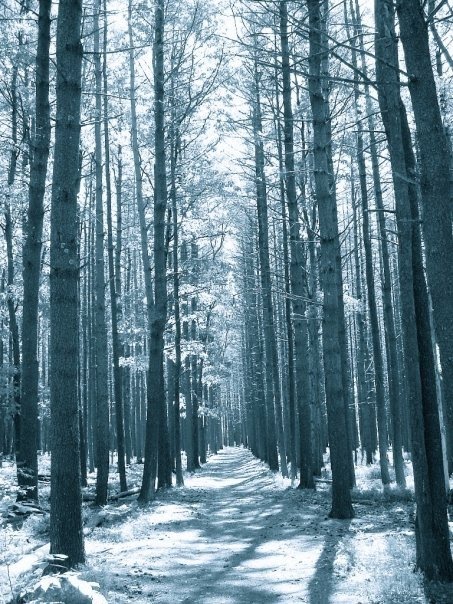
But there's one stretch of forest path that's wide, straight and blanketed not in boulders and beer cans but in springy pine needles that caress the feet and cushion the quads. And it's a stretch that makes you look up, up to the tops of the magnificent pine trees that line this magical alley. I call this place the Cathedral of Trees, and every time I come to it I stop running for a minute or two to take in its quiet beauty, breathtaking in any weather, season or time of day.

On my recent 70-degree-day run, after I'd entered the Cathedral of Trees and paused to contemplate shafts of sunlight piercing the pine canopy and illuminating the forest floor, I resumed running atop the soft carpet of needles. Suddenly my bounce was mirrored by a deer that leaped out of the forest onto the path in front of me. The buck had an adolescent rack that caught the sun as the animal sprang into the growth on the other side of the path. I stopped and watched him weave through the woods, come to a standstill about 50 feet from me, and turn his head to stare at me. He kept his body pointed away from me, in escape-ready mode, but moved his head to keep me in his sights as I slowly ran past him.
Thick streams of sun, transformed into color by the forest's fall foliage, washed over him, turning his gray-beige skin and antlers still covered in a young buck's velvet to a soothing shade of slate blue.
I was struck by the hue because it was so similar to that of a photograph of the Cathedral of Trees (above) my friend George had recently sent me. It was as if the deer had stopped in that light-drenched spot knowing he'd be turned that color. The blue made him part of the forest and the forest part of him, but his staying still to let me gaze at him made me part of the forest, too. We can both worship here in our cathedral was the message I ran away with.
Photo credit: George Farrell
www.LoriHein.com
Thick streams of sun, transformed into color by the forest's fall foliage, washed over him, turning his gray-beige skin and antlers still covered in a young buck's velvet to a soothing shade of slate blue.
I was struck by the hue because it was so similar to that of a photograph of the Cathedral of Trees (above) my friend George had recently sent me. It was as if the deer had stopped in that light-drenched spot knowing he'd be turned that color. The blue made him part of the forest and the forest part of him, but his staying still to let me gaze at him made me part of the forest, too. We can both worship here in our cathedral was the message I ran away with.
Photo credit: George Farrell
www.LoriHein.com
November 01, 2011
Talk about a captive audience
 I was dismayed to find, on a recent US Airways flight across the United States, that all the tray tables in economy had been turned into flying advertisements.
 For six hours I ate, drank, read and played with my iPod while staring at a sprawling message touting the speed of Verizon's 4G network. Since the same advertisement was affixed to every table in the cabin, it was literally in my face wherever I turned. I saw it 108 times on my 18-row walk to and from the bathroom.
Soon pilots will announce final approach with "Ladies and gentlemen, this is your captain. We've begun our descent into Podunk Airport. To prepare for landing, please secure your seatbelts and return your billboards to the upright and locked position. Thank you."
www.LoriHein.com
October 26, 2011
Makes me wonder how well the planes are maintained...

I flew out of Boston's Logan Airport last weekend. The trip got off to an inauspicious start when I got into an elevator in Terminal B and noticed this "FAIL" certificate posted on the elevator wall. The word "FAIL" staring at me as I made my vertical journey was scary enough, but my anxiety heightened when I realized I was enclosed in this mechanically compromised box on October 21, eight days after the expiration of the 90 Day Temporary Certificate, issued on July 13.
www.LoriHein.com
October 25, 2011
Adam Belanger: He's going places
My son Adam will graduate from college in May, and he's already begun his job search -- no flies on this kid. Allow me to hijack my blog in order to post his resume. Adam's looking for a professional entry-level position in sales/marketing/promotion/business development/customer service/sales support. Feel free to share this post with anyone who might be looking to add a smart, hard-working, entrepreneurial people person to their team:
Adam Belanger
Belanger.ad@gmail.com; 508-269-5347; 278 Parker Hill Ave., Boston, MA 02120
EDUCATION
Northeastern University, Boston, MA expected May 2012
Candidate for Bachelor of Science in Music Industry, Business Administration minor
• Courses in marketing, organizational behavior, accounting, financial management, business law
• Sigma Phi Epsilon Fraternity: mentored new members as Sigma Coordinator; delegate to North American Inter-Fraternity Leadership Academy and Carlson Leadership Academy; organize and execute semi-annual retreats, Coach, Mission Hill Little League Cardinals; do fundraising/community service
WORK EXPERIENCE
Huntington Wine and Spirits/K & R Concessions, Boston, MA March 2009 – present
Sales Associate/part-time Manager
• Assist in all phases of operation for family-owned liquor store and catering enterprise
• Interact with and serve hundreds of customers, vendors and distributors on weekly basis
• Handle cash and credit transactions; make bank deposits; monitor/ensure ID compliance
• Secure and close store; handle supplier and distributor deliveries, inventory and stocking
• Recruit, train and supervise new employees; represent company at vendor events
Impact Relations Music Promotion, Boston, MA May 2009 - present
Founder, Director, Entrepreneur
• Own and run company promoting album releases and tours
• Have executed publicity campaigns for over 30 shows, resulting in capacity turnout
• Secured repeat business from satisfied clients and new business through client referrals
• Write and distribute hundreds of press releases to online, print and radio media, resulting in interviews and reviews for clients
• Write and publish artist promotion blog: received work from and promoted over 300 artists
• Use social media extensively to discover, promote and communicate with artists, press and public
Nimbit, Inc., Framingham, MA January - June 2011
Marketing Intern at company providing promotional services to musicians
• Maintained marketing databases and executed direct marketing campaigns
• Tracked website performance, updated web pages, improved SEO, wrote HTML newsletters
• Contributed to company’s social media and blog
• Researched competitors and potential new business models and services
Victaulic Company, Mansfield, MA May - August 2008 & Jan. - July 2010
Office and Warehouse Intern at New England distribution center of world's leading manufacturer of mechanical pipe-joining products
• Managed high volume, time-sensitive distribution of materials between branch, corporate office, customers and sales staff
• Handled inventory control, database management, billing and sales support
• Worked in warehouse on shipping and delivery; earned forklift operator certification
Planetary Group, Boston, MA January - July 2009
Press Department Intern at music marketing company
• Assisted with publicity campaigns for artists' albums and tours, wrote press releases, managed press clips.
• Interviewed artists and wrote posts for company blog and interacted with media writers and editors
Other: Employed since age 13 at retail stores, marina, restaurants, band manager; world travel - have visited over 25 countries and 27 U.S. states; basic Spanish skills; licensed boat operator, enjoy basketball, snowboarding, golf; hard-working, responsible, reliable, self-starter, entrepreneurial, people and results-oriented
www.LoriHein.com
September 28, 2011
Park it
Wherever I travel, I seek out parks. They're places to rest between sightseeing sorties, eat the lunch food in your backpack, and, especially, people watch. Because parks are open to all and because all people need places to relax, reflect, recreate and regroup, parks are truly windows onto a place's diversity. There are few better ways to sense the depth, richness and variety of a place's inhabitants than to spend an hour in one of its parks. Here, some people I enjoyed watching one sunny afternoon in Paris's Parc des Buttes Chaumont, a gorgeous green space whose centerpiece is a lookout belvedere atop a rocky, 100-foot-high hillock (click the images to enlarge) :


www.LoriHein.com


www.LoriHein.com

Subscribe to:
Posts (Atom)